


The Weight of a Goodbye: Jacqueline Tan on Life, Loss, and the Work of Standing Beside Grief


There is a moment Jacqueline Tan returns to often — not an award ceremony, not a milestone in a thirty-year career, but a hand gripping hers, and a voice trembling through tears:
"Thank you. Having you here made this bearable."
It is a small exchange, over almost as soon as it begins. It will not appear on any certificate or performance review. But for Tan, an afterlife planner director who has spent years guiding grieving families through the hardest days of their lives, it is the entire reason she does this work — the moment that answers, again and again, a question most people never have to ask themselves out loud: why this job, of all jobs?
"What I've sent off isn't just a person who has passed," she says. "It's a family, learning to walk forward again."
That sentence — quiet, almost matter-of-fact — is the closest thing Tan has to a mission statement. Behind it sits a career built on a simple, unwavering belief: that every life deserves to be treated gently, and every farewell deserves to be treated with respect. Not because it's procedure. Because it's owed.
A Second Calling
Tan's path into death care was not a straight line, and it did not begin with loss. It began, unexpectedly, with real estate — the industry where she spent more than three decades building a career, and where, by most conventional measures, she succeeded. She closed deals. She built a name. She did well.
But success has a way of eventually asking its own question, and for Tan, it arrived somewhere in her later years in the industry: beyond the money, what am I actually leaving behind?
It's a question that many people ask themselves privately and few ever act on. Tan did. She left real estate and stepped into what she now calls "life services" — an industry most people spend their whole lives trying not to think about.

What has kept her there since, she's quick to clarify, was never the performance numbers. It was something closer to a calling: a conviction that families deserve the chance to plan ahead, so that when the moment comes, what's left behind is love — not debt; memory — not regret. She sums up the philosophy in a phrase that sounds almost like a proverb, the kind of line she repeats to families weighing whether to plan ahead at all:
leave behind love, not debt; leave behind memory, not regret.
"That sense of purpose," she says, "has never changed. Not once, from the day I started."
The Moment That Confirmed Everything
Ask Tan for the single moment that convinced her she'd made the right choice, and she doesn't point to an industry accolade. She points to a hand.
It happened, as these moments tend to, without warning — mid-conversation, mid-arrangement, in the middle of a family's worst week. A relative reached for her hand and, through tears, thanked her simply for being present. For making the unbearable slightly more bearable.
"Every time I hear those words," she says, "I feel more certain of the path I've chosen." It isn't the applause of a stage or the recognition of a peer that validates the work for her — it's the quiet, private gratitude of someone she'll likely never see again after the arrangements are complete. She describes it almost as a form of proof: proof that what she offers a family isn't just logistics, but something they'll carry with them long after the service ends.
What the Work Actually Asks of You

There's a particular kind of pressure built into Tan's job — one that most professions don't require by default. Every family she sits with is, by definition, living through one of the worst days of their lives. There is no easing into the relationship, no small talk to warm things up. Grief is already in the room before Tan arrives.
She says the way she carries that weight is almost an act of borrowing — borrowing courage from the families she serves, and returning it to them in a different form.
"If they can find the courage to face losing someone they love," she says, "then I owe them the same courage in return."
It's a kind of quiet reciprocity: their willingness to face the unbearable becomes her permission to stay steady for them. Underneath it, she holds onto a belief that sounds simple but clearly isn't easy to practice — that difficulty passes, and that compassion, applied consistently and without shortcuts, tends to find its way through even the hardest days.
Defining a "Good Goodbye"
Strip away the professional vocabulary — the logistics, the paperwork, the procedures — and ask Tan what a "good goodbye" actually looks like to her, personally, and her answer has nothing to do with execution.
A good goodbye, she says, isn't a flawlessly run ceremony. It's something closer to completion. It's the words that needed to be said, finally said. The love that needed to be shown, finally shown. The regrets that had built up over months or years or decades, finally allowed to be set down instead of carried forward.
It's a goodbye that lets the departed leave in peace — and just as importantly, lets those who remain keep living without being weighed down by everything left unsaid.
This is, in many ways, the quiet standard Tan holds herself to in every arrangement: not "did the ceremony run smoothly," but "did this family get the chance to finish what needed finishing."
The Misunderstood Side of the Job
If there's one thing Tan wishes more people understood about her industry, it's this: the assumption that her days are defined by heaviness, by death, by sorrow — and that this assumption misses almost everything that actually fills her working hours.
In practice, she says, the job is defined by what death makes visible: love, duty, family, and an ongoing, unplanned education in what life is actually for.

"We're not in the business of death," she says. "We're guardians of a person's final dignity — and companions to a family finding its footing again." It's a distinction she returns to often, because it reframes the entire profession: not an industry oriented around endings, but one oriented around care, delivered at the moment care is needed most.
Taking the Work Home
The effects of this career, Tan says, don't stay contained to working hours. They followed her
home, and over time, reshaped how she shows up in her own relationships.

She describes becoming more patient. More grateful. Less inclined, in the ordinary business of daily life, to treat any relationship — a parent, a child, a friendship — as something guaranteed to still be there tomorrow. She finds herself checking in on her parents more often, being more present with her children, thanking friends more readily, making a more deliberate effort to be there for the people already in her life.
"I know now," she says, "that no relationship should ever be taken for granted."
It's a lesson that would be easy to state as a platitude, but for Tan, it's something closer to lived practice, reinforced every time she sits across from a family confronting exactly what happens when time runs out.
What Death Has Taught Her About Living

If there's a single lesson Tan says this career has given her — the one that sits above all the others — it's that proximity to death sharpens appreciation for life in a way little else can.
"Don't save love for later. Don't save presence for tomorrow,"
she says. "We never know if today's goodbye is the last one." It's advice that could sound abstract coming from someone else. Coming from Tan, who has sat with the aftermath of that exact scenario more times than she can count, it carries a different weight.
Her conclusion, stated plainly: loving well and showing up while you can is, in her view, the single greatest form of happiness available to anyone.
Changing the Conversation Around Death
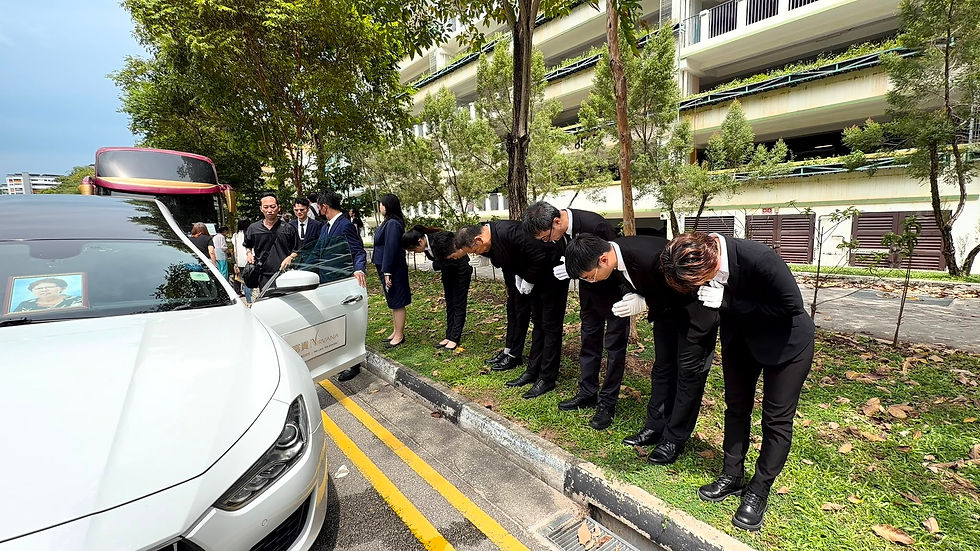
If Tan could change one thing about how society at large approaches mortality, she wouldn't reach for a policy or a program. She'd reach for a conversation — specifically, the one most families avoid having until it's too late.
Death, in her view, has been wrongly treated as something inauspicious, something to be talked around rather than talked about. She'd like to see that shift. Not toward morbidity, but toward honesty: an understanding that death is simply part of life, and that the earlier families engage with that fact, the more freely they can live, and the lighter the burden they leave behind for the people who love them.
She frames it as a redefinition of what it actually means to provide for a family. Real love, she argues, isn't only measured in what you leave behind financially. It also means having the harder conversations while there's still time to have them — and doing the quiet work of making the final chapter easier, before it ever arrives.
The Thought She Hopes People Keep
After the ceremonies, after the years, after every family she's guided through the hardest week of their lives, Tan says there's one line she hopes outlasts her in the minds of the people she's met:
The end of a life is not the end of love.
It's the thought she returns to when asked what she'd want people to walk away with — not a technique, not a piece of planning advice, but a reframing of loss itself. Love, in her framing, doesn't end where a life does. It continues, carried forward by the people who remain.
"I hope we can all cherish the present, love well," she says, "and when the day comes to say goodbye, leave without regret — carrying love all the way through."
Considering a Career in Life Services?
Tan is quick to note that this path isn't for everyone — but for those who feel drawn to it, she's happy to talk. If her story resonates and you've ever considered a career built around compassion, service, and standing beside families in their most difficult moments, reach out directly via WhatsApp at +65 9656 6947 or scan this QR


Comments