


Light, Instinct, and the Long Game: Inside the Frame with Bao Le Cheok

FLUX MEDIA Personality Feature

There's a particular kind of cinematographer who thinks in emotion before they think in equipment — who sees a scene and feels its temperature before they ever call for a light stand. Bao Le Cheok is one of those. Ask her about a scene from a surrealist horror-comedy shot on 35mm film, and she won't start with the Panavision Millennium XL2 or the Kodak stock. She'll start with the feeling the frame needed to hold.

That instinct has carried Bao Le Cheok from a fading, half-forgotten tourist park in Singapore to soundstages and sets across Los Angeles, and most recently, through the halls of the American Film Institute, where she graduated this year with a Master's in Cinematography.
From Painters to Painted Light
Long before AFI, there was Haw Par Villa — a documentary Bao wrote, produced, and shot about the last painter still working in a fading tourist attraction in Singapore. It's a small, quiet film about a person holding onto a disappearing craft in a world that's moved on. It's also, in hindsight, a fitting origin story: a young filmmaker drawn not to spectacle, but to the people quietly keeping something alive.
Nine years later, that instinct hasn't changed — it's just been given better tools, bigger canvases, and a lot more crew positions under her belt.
A Career Built From the Ground Up

What sets Bao apart isn't just her eye — it's the fact that she's earned it from every position on set. Camera Intern. Camera Assistant. Camera Operator. Gaffer. Key Grip. Cinematographer. It's the kind of ground-up fluency that shows up not as jargon, but as trust — the calm of someone who has stood in nearly every role on a crew and genuinely understands what everyone else needs from her.
"I find that having the chance to work in so many roles definitely helped me in my leadership position as a cinematographer," she says. "I gained a lot of valuable insight into how each department contributes to creating the visuals I envision. Filmmaking is never a one-person job — and through the years, I've been able to pick up tips and tricks from people who've specialized their trade in these roles."
That history now shapes who she chooses to work with. "Being part of those positions in the past really helped me curate the people I work with today. While I have confidence in the planning and shots I have in mind, I often leave space for feedback and room for improvement from my teammates. It's a mindset I hope to carry forward as I continue to grow in my craft."
Two Films, Two Very Different Kinds of Truth
This year's AFI slate captures that range perfectly — and both films happened to be in production at the same time.
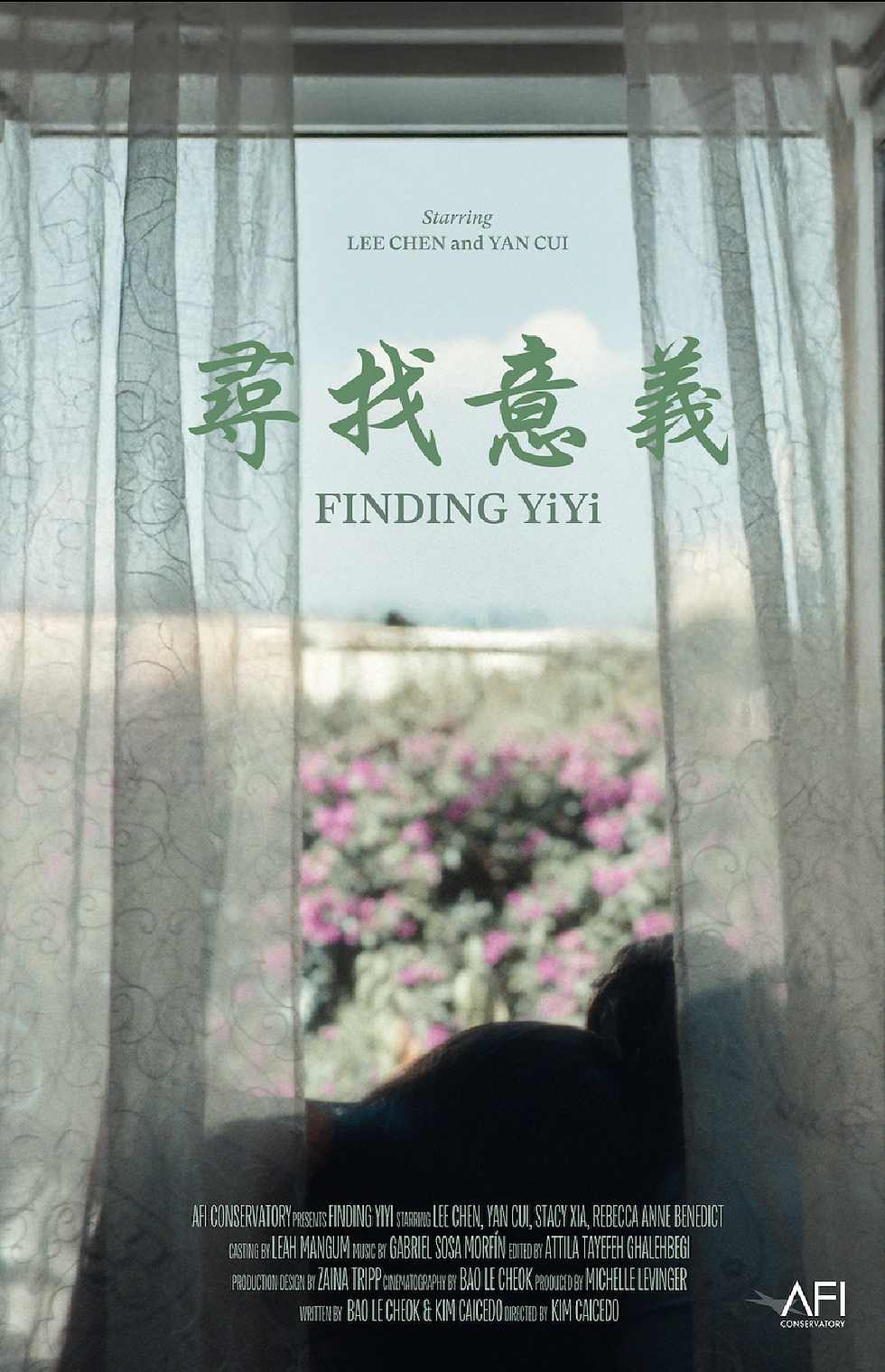
"Finding Yiyi" is a slice-of-life LGBTQ+ short about sapphic longing between two older women, co-written and shot by Bao alongside director Kim Caicedo. "Our inspirations heavily leaned towards directors like Wong Kar-Wai, with his romantic noir approach to love, and Asian cinema references like Edward Yang," Bao explains. One of the film's most demanding sequences — a follow-dolly shot sweeping through the aisles of a supermarket as former lovers Yiyi and Lucy pass through the same space at different times of day — took extensive planning to translate from page to frame. "On paper, it was written that Lucy and Yiyi passed by each other like ships in the night. I remember vividly discussing how we were going to visually film that."
The short has since become a genuine festival favorite: a Cannes Indie Shorts semi-finalist, selected across the Beverly Hills Film Festival, the New Jersey International Film Festival (which gave the film its own feature write-up), LGBTQ+ Toronto, and the Honolulu Rainbow Film Festival.

"Eggsecution," meanwhile, sits at the opposite end of the tonal spectrum: a surrealist horror-comedy shot on 35mm with a Panavision Millennium XL2, directed by Japhet Velazquez, set in the hyper-real, American Dream-inspired home of a housewife with a strange addiction to eggs. "This ended up being one of the more challenging but also most rewarding films I've ever worked on," Bao says. With practical special-effects horror in play, pre-production planning with the makeup and costume teams — and keeping camera and lighting gear practical for the film's exposure needs — was essential. Visual references came from an unexpected mix of sources: "A lot of my visual design and research came from old vintage books and drawings of weird monsters or renditions of chickens. Creepypasta and internet horror imagery also became unexpected references."
Producing two visually opposite films in parallel meant learning to compartmentalize. "There were many times I'd be stretched thin — discussions with different directors about different visions all happening at once. What helped ground my work was doing in-depth research and planning for each project. I made sure I had some sort of bible guiding me in my equipment planning, lighting, visual style, and approach."
The result: "Eggsecution" has already picked up "Best Cinematography" at the Purgatory Film Festival (UK) and "Best Surreal" in Milan, with selections at Final Girls Berlin, ScumDance, and Midsummer Scream's The Screaming Room — and Screamfest, HollyShorts, and Alter still ahead on the festival run.
The Thesis Film That Keeps Winning

Go back further and you'll find "Mosquito," Bao's undergraduate thesis film from Nanyang Technological University in Singapore — a family drama with a horror twist about filial piety pushed past its limit. Five years on, it's still racking up honors: Best Short Film and Best Sound Design at the Kraken International Film Festival, Best Horror Film at Hollywood Just4Shorts, and — as recently as 2025 — the Bangkok Society of Film Critics' Award at the Bangkok Movie Awards.
A student film that's still winning awards half a decade later isn't luck. It's evidence of a frame built to last.
Building a Life in LA
Moving from Singapore to Los Angeles for AFI wasn't just a creative leap — it was a full reset. "The biggest adjustment was the realization that no matter where I lived, life as a freelance cinematographer would still come with the same uncertainties," Bao reflects. "The struggle of finding your tribe to make films with, and putting in consistent effort to connect with new people you'd want to keep working with — all of that takes time to build, especially when you've uprooted your life."

Freelancing, she's found, doesn't get easier just because the skyline changes. "Even today, I struggle with finding jobs and understanding that work isn't constant — it comes in waves. But moving has trained me to be more familiar with the adulting side of things: owning a car, being more financially aware and frugal, and making decisions that are good not just for the short term, but the long term."
A normal week now is a balancing act of hustle and recovery. "I'm organizing my calendar, arranging meet-ups with fellow filmmakers at least once a week, and trying to work out daily. If there's work, sometimes I end up working every day, coming home at ungodly hours, doing overnight shoots that are sometimes unavoidable." Her reset button, though, has less to do with film than with fresh air. "Sometimes the best way to get over a creative slump isn't to watch movies, but to go out and run, hike, and feel the wind on your face. They always say art imitates life, and I couldn't agree more." Lately, that's included badminton with friends — "a way to enjoy a physical activity together, catch up, and sometimes even have a fulfilling meal after."
Cooking as Ritual
Cooking and spending time with animals are Bao's two stated ways of unwinding — and cooking, specifically, has become a kind of after-hours therapy. "Many people would choose sleep over a meal after a long shoot day. But for me, the steps and intricacy of making a great, satisfying meal for myself is the therapy," she says. "Growing up in Singapore, enjoying food is part of the culture, and it's become a comforting ritual to complete even after a crazy, tiring twelve-hour day at work." There's no go-to recipe — just whatever's in the fridge. "I often view it as a challenge to create something delicious from bits and pieces. It results in so much satisfaction."
What AFI Really Taught Her

Off set, Bao spent time in formative rooms beyond the camera department — workshopping a feature script alongside acclaimed director Tony Kaye, and serving as an AFI Teaching Assistant, reviewing fellow cinematographers' creative process books.
What stayed with her most wasn't a technique, but a shift in mindset.
"One of the most eye-opening aspects of AFI was being surrounded by artists at completely different stages of their lives and careers — Fellows ranged from their early twenties to their forties, and everyone approached storytelling in their own unique way," she says. "A younger cinematographer might approach a scene with bold experimentation, while someone with more experience might rely on instincts refined over many years. Neither approach was necessarily right or wrong — they were simply different."
That realization changed how she approaches her own work. "It taught me that cinematography isn't about following a fixed set of rules, but about discovering the approach that best serves the story. By the end of my time at AFI, I felt far more confident experimenting with lighting, composition, and visual storytelling without constantly second-guessing myself."
As she puts it: "There is rarely a single 'correct' way to create something. Everyone is figuring things out, regardless of where they are in their career. Once I stopped viewing filmmaking in such black-and-white terms, I gave myself permission to fail, learn, and try again."
What's Next
Post-AFI, Bao is deliberately staying open. "I'm on the side of remaining open to wherever the work can take me. The more open I am to different stories, the more I'll learn about different genres — and who knows what path that can lead me down."
That said, genre still has a hold on her. "I think I'll always have a soft spot for genre stories, be
it creating, reading, or just watching them on screen. If those kinds of stories are harder to come by, I'm still actively writing my own." That includes "Motion Lotion," a self-directed and self-shot experimental short currently in post-production — a strange, playful story about a snail lady that Bao is hoping audiences will look forward to.
And if she had to be remembered for just one film? "Perhaps that would be 'Eggsecution.' The film came from something deep within my admittedly obsessive fascination with eggs, and the vision that came with it was so much fun to make. I hope audiences are both fascinated and repulsed by it in equal measure — that they experience the same strange mix of curiosity and discomfort that inspired the film in the first place."
The Throughline

If there's a single thread running through Bao Le Cheok's decade in production, it's this: she shows up for the people telling the story, not just the story itself. Whether she's lighting a horror-comedy on 35mm or lensing a tender queer romance, whether she's gaffing someone else's vision or directing her own strange snail-lady universe, the constant is a collaborator who's genuinely in service of the frame — not the ego behind it.
That's a rarer thing in this industry than it should be. And it's exactly why the festival circuit — and Los Angeles — keep calling her name.
Follow Bao Le on her Instagram:
FLUX MEDIA


Comments